Dakota Gas brings pipeline safety insights to local producers
01 April 2026
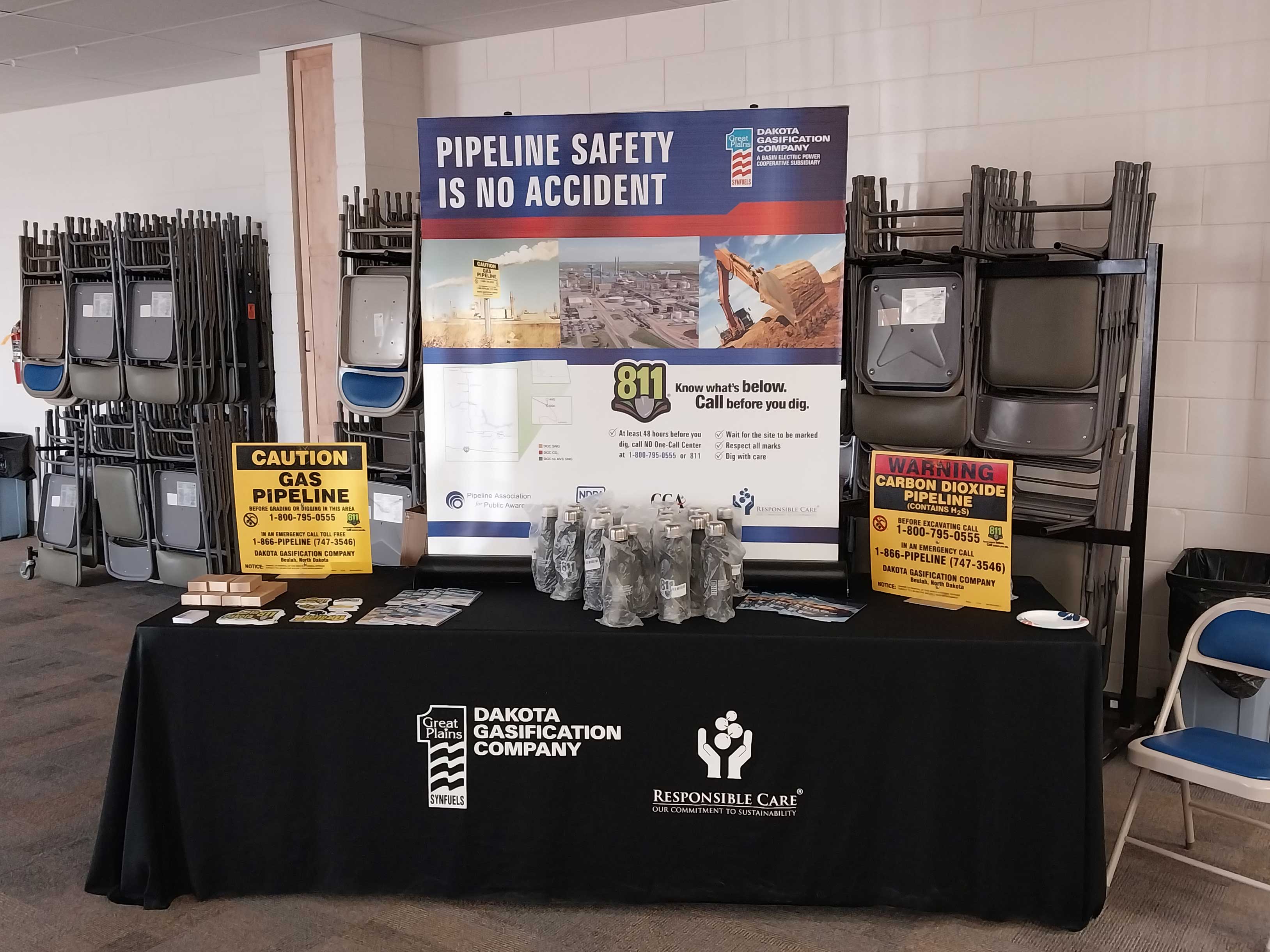
A Dakota Gas pipeline safety booth provided 811 and CO₂ pipeline guidance during the NDSU Extension event.
Dakota Gasification Company (Dakota Gas), a subsidiary of Basin Electric, shared key insights on underground utility safety during the North Dakota State University Extension Mercer County “Think Spring” Educational Workshop on March 23. Speaking to farmers, ranchers, and area residents, Kurt Dutchuk, pipeline and protection services superintendent at Dakota Gas, emphasized the importance of using the North Dakota 811 One Call system and understanding the risks associated with buried infrastructure. The One Call program serves as North Dakota’s statewide notification system, giving utility operators advance notice of planned digging so they can mark underground lines and prevent accidental strikes.
Dutchuk noted that the workshop was one of many safety trainings Dakota Gas conducts each year across western North Dakota. “In this specific training, we reviewed the One Call system with the attendees, how to submit One Call tickets, reviewed utility damages over the past year, and discussed how to work safely around and near underground utilities.”
A significant portion of the presentation focused on carbon dioxide (CO₂) pipeline safety. Dutchuk explained that CO₂ pipelines operate uniquely, which requires additional precautions. “CO₂ pipelines operate under the highest pressure of any other commodity transported via pipeline in North America,” he said. “With that alone, we take greater precautions to protect them from line strikes.” He added that Dakota Gas maintains a 2,500‑foot notification corridor through the One Call system, a buffer he said, “has given us a nice zone to lower our risk against damage.”
Dutchuk emphasized that the One Call process is central to that protection. “With the 811 One Call notification, we get early indications of exactly where the contractors may be working in vicinity to our CO₂ pipelines,” he said. Early notice allows Dakota Gas to meet with contractors, review company procedures, and locate pipelines in the field. “We require a Dakota Gas pipeline representative to be present on the job site anytime a job would encroach onto our pipeline right‑of‑way,” he said. “That alone adds another layer of protection against line strikes.”
He also highlighted several recent updates to North Dakota’s One Call laws that strengthen safety for both contractors and utility operators. One change is mandatory white lining, which requires excavators to clearly mark their intended work area. “This has helped utility owners to better mark out the correct location in the field,” Dutchuk said. He also pointed to the state’s positive response requirement, which obligates utility owners to notify excavators of the status of their locate request.
Another update — adding “dredging” to the legal definition of excavation — is particularly important for Dakota Gas. Dredging, which involves removing sediment or debris from the bottom of lakes, rivers, or other waterways, can disturb buried infrastructure if not properly reported. “To most, this doesn’t seem that significant,” Dutchuk said, “but to operators like Dakota Gas, who own and operate a pipeline that crosses Lake Sakakawea, it is very significant.” Before the change, dredging activity near underwater pipelines was not required to be reported through the One Call system, creating what he described as a large risk to underground utilities that are located under waterways.
Throughout the presentation, Dutchuk reminded attendees that underground utilities are more extensive and potentially hazardous than many people realize. “There are far more pipelines and utilities buried than most people would ever guess,” he said. He emphasized that the One Call system is free to use and funded by utility owners. “We have a legal system in place that, when utilized correctly, will greatly reduce the risk of striking any underground utility,” he said. “Always call before you dig.”
Dakota Gas also displayed one of its pipeline safety booths at the event as part of its ongoing outreach to promote safe excavation practices.
Basin Electric wants all interested and qualified candidates to apply for employment opportunities. If you are an applicant with a disability who is unable to use our online tools to search and apply for jobs, or who needs other assistance or accommodations, please contact us at 701-223-0441. Please indicate the specifics of the assistance needed or provide your contact information, and a Basin Electric Human Resources representative will contact you. Basin Electric is an Equal Employment Opportunity Employer regarding race, color, religion, sex, sexual orientation, gender identity, national origin, disability, and veterans status.