Groton Generation Station celebrates 20 years of innovation on the Great Plains
Jenifer Gray
05 November 2026
In 2006, Groton, South Dakota, became home to a technological milestone. In the early morning hours of July 1, Groton Generation Station Unit 1 began commercial operation, launching one of the world’s first applications of a technology that would later be adopted around the globe.
Located five miles south of Groton, Basin Electric’s Groton Generation Station Unit 1 introduced the first commercial application of General Electric’s (GE) LMS100® simple cycle gas turbine. The turbine, unlike anything in the world at the time, represented a new class of engineering. Part of it came from jet engine design, which allowed it to start very quickly, and part of it came from traditional heavy duty power turbines, which gave it the strength and durability needed for utility use. This capability allowed the plant to ramp from a complete shutdown to generating 95 megawatts of electricity in just a few minutes.
“Purchasing the first LMS-100 turbine from GE enabled Basin to be an industry leader in adopting advanced energy technology in rural South Dakota,” Chris Karch, plant manager South Dakota generation, says. “The project improved generation efficiency and reliability to cooperative members and helped demonstrate the capabilities of a technology that would go on to influence power generation across the industry.”
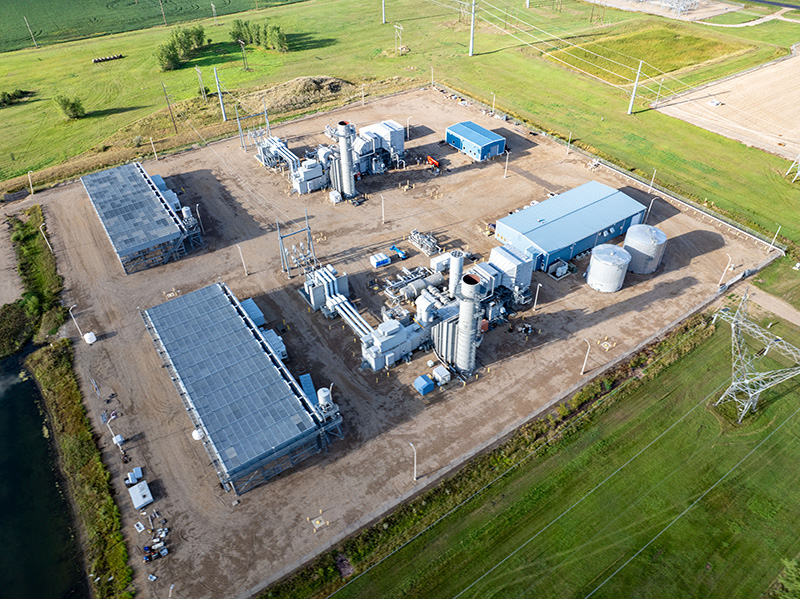
Aerial view of Groton Generation Station.
Groton Generation Station came on at a time when Basin Electric was experiencing steady load growth and expanding its service territory into Minnesota. New long-term power contracts increased the cooperative’s obligation to supply additional electricity, and national energy policy was shifting away from large coal units toward more flexible natural gas and renewable resources.
With the lessons of past overbuilding still in mind, Basin Electric chose a more incremental approach to adding capacity. Wind projects, recovered energy units, and fast-start natural gas facilities became key parts of that strategy. “Combining Basin’s need for peaking power with Groton’s access to natural gas and water resources made it an excellent location for the new GE LMS-100,” Brian Jones, Basin Electric operations and maintenance supervisor at Groton Generation Station, says. “Its proximity to Basin Electric 345-kV and Western Area Power Administration 115-kV substations made sense.” In this environment, Groton Generation Station provided reliable peaking power and system support needed to meet rising demand.
The facility also came with a lower installation cost than many of the baseload resources built in the 1980s, which were designed to operate continuously and were less flexible in responding to changing system needs. “By adding peaking generation, Basin was able to make more optimal use of its existing generation assets while creating a more balanced and adaptable resource portfolio,” Becky Kern, Basin Electric vice president of Resource Planning and Rates, says. “Groton was among the first facilities to help diversify Basin’s generation mix, signaling a shift toward a broader strategy that combined reliability, flexibility, and cost-effective capacity additions.”
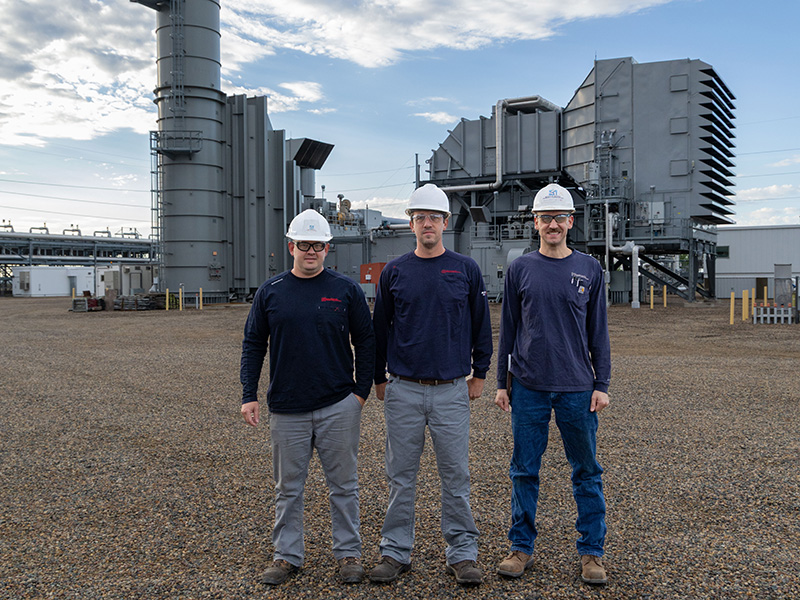
From left to right: Zane Fees, operator technician I, Brian Jones, operations and maintenance supervisor, and Drew Prentice, operator technician I, at Groton Generation Station.
Over the past two decades, Groton Generation Station’s role has evolved along with the electric grid. “When the station was first commissioned, it operated only as a peaking power plant,” Jones says. “Since joining the Southwest Power Pool in 2015, however, it has increasingly operated as a load-following plant. The amount of electricity generated annually between 2006 and 2015 is now produced in a single month.”
At the same time, renewable energy generation has grown more than tenfold. Because renewable output can change from minute to minute, fast-response plants like Groton Generation Station are more important than ever. Their ability to quickly start up and adjust output helps balance those fluctuations and maintain grid reliability.
Today that flexibility remains critical. “As more renewable energy has become available, natural gas generation facilities like Groton are needed to quickly start up and provide a backstop if wind and solar generation does not meet the forecasted load schedule,” Karch says. “Having 200 megawatts of dispatchable power that can be brought online within 10 minutes ensures that the transmission system remains reliable.”
As the station celebrates 20 years of operation, recognition goes to the employees, both past and present, whose dedication has shaped its success. Their expertise, hard work, and commitment have enabled the station to deliver dependable performance, support Basin Electric’s changing generation needs, and advance innovation in serving rural electric cooperatives.
Basin Electric wants all interested and qualified candidates to apply for employment opportunities. If you are an applicant with a disability who is unable to use our online tools to search and apply for jobs, or who needs other assistance or accommodations, please contact us at 701-223-0441. Please indicate the specifics of the assistance needed or provide your contact information, and a Basin Electric Human Resources representative will contact you. Basin Electric is an Equal Employment Opportunity Employer regarding race, color, religion, sex, sexual orientation, gender identity, national origin, disability, and veterans status.