Closing the Loop: Taking Nutrient Recycling into a Catalyst for Innovation
Kalli Senske
16 June 2026
For thousands of years, nutrients cycled naturally between livestock, crops, and soil. Today, that cycle is harder to maintain — especially in southwestern Iowa where agricultural and food processing is abundant, but livestock manure is increasingly limited. Abe Sandquist, president of Natural Fertilizer Products, sees that imbalance as an opportunity to rebuild a more complete system.
“Between Omaha and Sioux City there is a tremendous amount of agricultural and food processing, which creates organic by-products that still contain valuable nutrients,” Sandquist explains. “At the same time, this region has less livestock manure available than other parts of Iowa. That gap is where the opportunity is.”
That realization traces back to a defining moment early in Sandquist’s career. While working as a soil conservationist with USDA Natural Resources Conservation Service, he saw firsthand how nutrients were leaving the farm system and not making their way back to the soil.
“That was really the lightbulb moment for me,” he says. “We were managing nutrients on the farm side, but there was a whole stream of valuable nutrients outside of agriculture that weren’t being returned. I started thinking about how we could connect those dots.”
Nearly 20 years ago, Sandquist founded Natural Fertilizer Products with a focus on doing just that — bringing nutrients back into the system in a practical, agronomically sound way.
“Composting and stabilizing organic materials allows us to complete the nutrient cycle and make better use of resources that already exist,” Sandquist says.
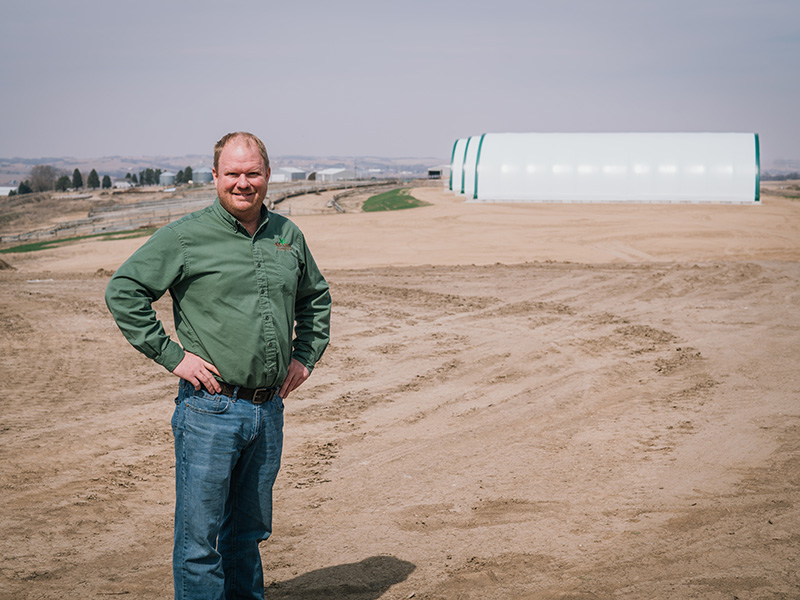
Abe Sandquist stands in front of what will be a WINR Center. Photos courtesy of Rachel Rogers, communications specialist at Northwest Iowa Power Cooperative.
The company’s natural fertilizers contain organic matter, carbon, micronutrients, and biological activity that improve soil structure, water infiltration, and nutrient efficiency over time.
“We’re not just feeding a crop for one season,” he says. “We’re building a system that improves the soil and helps every input work better.”
The business began with manure management and composting, creating customized blends for local farms. As the company grew, Sandquist saw an opportunity to expand that model and bring more organic nutrient streams back into agriculture in a responsible way.
A WINR Center — short for Waste Into Nutrient Recovery — is designed to capture nutrients from organic materials and return them to the soil in a consistent, controlled, and efficient manner. Sandquist is building two WINR Centers in western Iowa, including one served by Basin Electric class C member Harrison County Rural Electric Cooperative (REC) headquartered in Woodbine. Construction on the first two facilities began this spring, and land has been secured for a third site to serve the surrounding region.
Each WINR Center operates within a localized footprint, collecting materials from nearby sources and returning finished compost to area farms. This approach keeps value close to home while reducing transportation needs and improving efficiency.
The facilities use advanced processing systems to transform a wide range of organic materials into high-quality soil inputs. A de-packaging system separates materials from containers and packaging, allowing nutrients to be recovered and reused.
Inside multiple aerated buildings, compost is placed on specialized concrete floors where controlled airflow accelerates the natural decomposition process. This system significantly reduces composting time while maintaining consistency and lowering emissions. Automated controls for oxygen, temperature, and moisture ensure a high-quality, reliable product.
WINR Centers track incoming materials and produce targeted nutrient blends so products can be applied where they provide the most value. The result is a system that supports farmers, improves soil health, and strengthens the broader agricultural economy.
“When people see the initiative it takes to build something like this, it inspires them to think differently and explore new possibilities,” Kert Barnum, economic development director at Harrison County REC, says.
That innovation carries through to the local economy. From construction to long-term operations, the project supports jobs in trucking, operations, agronomy, and procurement, along with local contractors and service providers.
Reliable electricity is a critical component of the WINR Centers expansion.
Harrison County REC has supported the project from early planning stages — helping evaluate power needs, design service infrastructure, and ensure dependable electricity as the project moves forward.
“Without strong rural power infrastructure, projects like this would be much more difficult to operate,” Sandquist says.
He credits the cooperative’s understanding of agriculture and rural business as a key factor. “Harrison County REC has been a great partner,” he says. “They’ve taken the time to understand what we’re building and what it requires, and they’ve been proactive in helping us get there.”
For the cooperative, the project aligns closely with its mission. “For us, it’s about living the Cooperative Principle of Concern for Community,” Kristi Travis, director of communications and IT at Harrison County REC, shares. “We’re fortunate this is in our service territory, but we support economic development regardless of location. Projects like this give people the opportunity to build a life here, stay here, and thrive here.”
With that commitment to community in mind, Barnum emphasizes that developments like the WINR Centers are key to maintaining a strong rural system. He encourages Basin Electric’s member cooperatives to embrace new projects like Sandquist’s.
“For our cooperative to remain strong and keep rates steady, we rely on new services,” he says. “We’re always excited to bring on loads like this because they provide value and help keep things sustainable for our members.”
For Harrison County REC and the communities it serves, the WINR Centers represent more than new electric load; they represent a long‑term investment in agriculture, soil health, and rural vitality.
By returning nutrients to the soil and keeping that value local, Sandquist’s approach helps rebuild a system that benefits farmers, communities, and the future of agriculture.
The first facility is expected to begin processing in July 2026, marking another step forward in completing the nutrient cycle.
Basin Electric wants all interested and qualified candidates to apply for employment opportunities. If you are an applicant with a disability who is unable to use our online tools to search and apply for jobs, or who needs other assistance or accommodations, please contact us at 701-223-0441. Please indicate the specifics of the assistance needed or provide your contact information, and a Basin Electric Human Resources representative will contact you. Basin Electric is an Equal Employment Opportunity Employer regarding race, color, religion, sex, sexual orientation, gender identity, national origin, disability, and veterans status.