Teamwork in action: Spirit Mound transformer bushing replacement
Jenifer Gray
27 January 2026
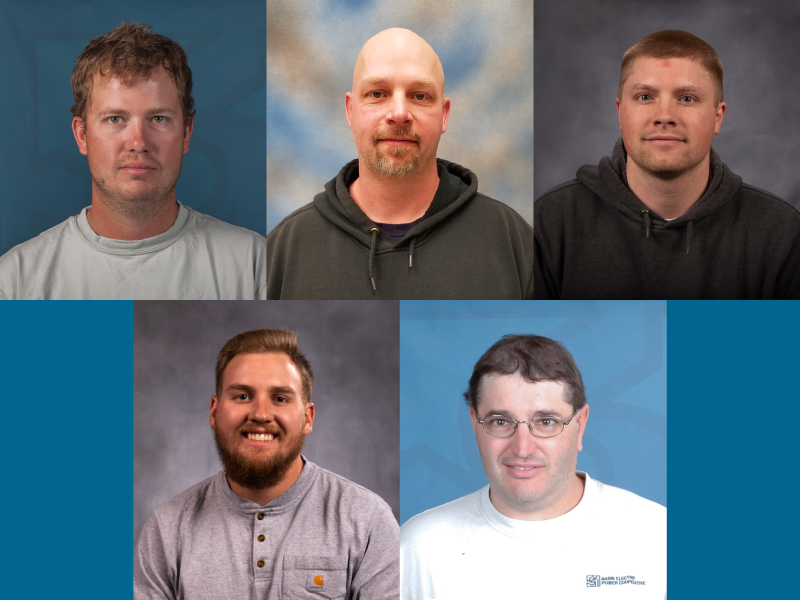
Harold McDaniel, TSM substation electrician, Joe Schmit, TSM substation electrician, Tyler Horn, TSM substation electrician, Logan Rietveld, TSM substation electrician, and Adam Malsom, TSM lead substation electrician.
Behind the reliable delivery of electricity are countless components that quietly do their job every day. One of those essential parts is the bushing, a device that plays a critical role in keeping high-voltage equipment safe and functional.
A bushing allows an electrical conductor to pass safely through a grounded barrier, such as the tank wall of a transformer, circuit breaker, or switchgear. It provides two key functions: electrical insulation and mechanical support. The bushing isolates the high-voltage conductor from grounded metal surfaces while holding it securely in place and maintaining a tight seal against the pressure inside the equipment. Constructed from materials like porcelain, resin, or oil-impregnated paper, bushings are designed with external sheds or skirts to prevent flashover and often contain oil or gas chambers to manage electrical stress and heat.
Bushings are found in power transformers, circuit breakers, and current or potential transformers, each relying on their insulating properties to ensure safe and efficient operation. Because of their critical function, bushings are closely monitored through infrared and visual inspections and periodic testing. These inspections and tests detect early signs of insulation breakdown, moisture intrusion, or partial discharge that could lead to catastrophic failure.
During a routine five-year maintenance inspection on the Spirit Mound Generator Step-Up Transformer KY1A, power-factor testing revealed that one of the bushings’ insulation systems had deteriorated with age. The test results showed a deviation beyond acceptable limits when compared to both the manufacturer’s baseline values and previous maintenance data. This indicated that the bushing’s insulating ability was no longer sufficient, and the bushing needed to be replaced.
“If a bushing fails due to insulation breakdown, moisture ingress, or excessive partial discharge, it can result in catastrophic equipment damage,” Nathan Helbling, substation superintendent, says. “That’s why periodic inspections and electrical testing is done regularly to monitor bushing health.”
The bushing replacement was carried out by Transmission Systems Maintenance (TSM) substation electricians Harold McDaniel and Joe Schmit from Beulah, North Dakota, and Tyler Horn, Logan Rietveld, and lead substation electrician Adam Malsom from Huron, South Dakota. Horn, Rietveld, and Malsom removed Transformer KY1A from service on September 16 as part of the scheduled maintenance outage. During that time, the crew identified and replaced the defective low-voltage bushing. Thanks to strong coordination among multiple TSM departments, including Planning, Operations, and Warehouse, the team safely returned the transformer to service by September 25.
“Completing a generator step-up transformer bushing replacement in just nine days is quite an accomplishment,” Helbling says. “The teamwork demonstrated throughout the process ensured minimal downtime and directly supported system reliability by enabling the Spirit Mound Generation Station Unit 1 generator to return to full availability for generation.”
By working together, the Spirit Mound Generation Station Unit 1 will continue Basin Electric’s mission to provide reliable, affordable power to its members.
Basin Electric wants all interested and qualified candidates to apply for employment opportunities. If you are an applicant with a disability who is unable to use our online tools to search and apply for jobs, or who needs other assistance or accommodations, please contact us at 701-223-0441. Please indicate the specifics of the assistance needed or provide your contact information, and a Basin Electric Human Resources representative will contact you. Basin Electric is an Equal Employment Opportunity Employer regarding race, color, religion, sex, sexual orientation, gender identity, national origin, disability, and veterans status.